Para-cycling Road UCI World Cup Sergovia

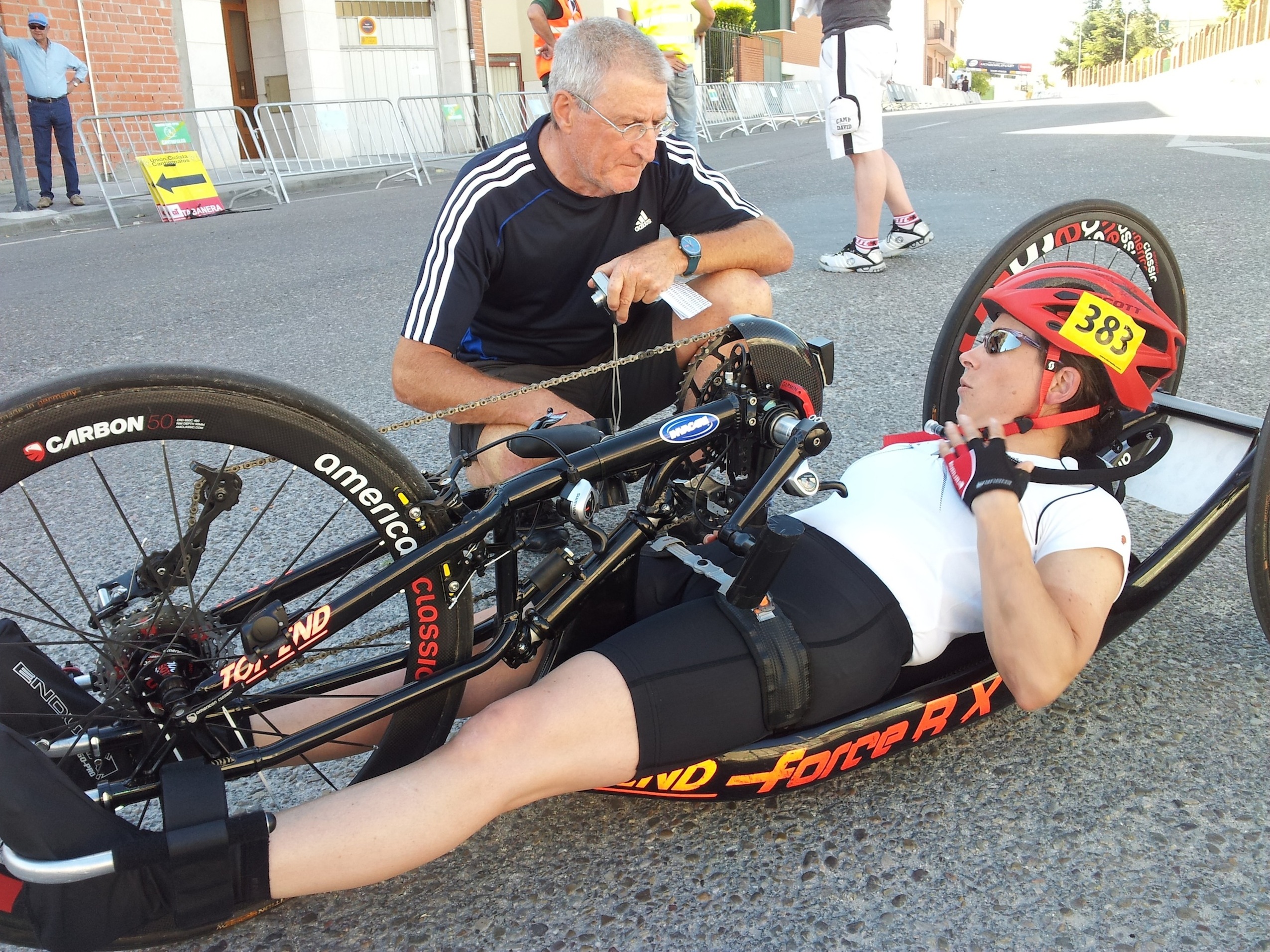
Pep talk before the TT

Pep talk before the TT

It was with trepidation that I travelled to Spain to compete in another UCI Para-cycling World Cup this time against the worlds top female hand cyclists, all of whom had competed in London 2012 Paralympics. To be able to compete Internationally in Para-cycling required me classified again and my appointment had been allocated a few days prior to the competition which meant I had time to do a few training rides in the sunshine.

Unfortunately, I didn’t take into account the topography of the area where the official Hotel was situated and my ‘easy’ ride turned into a bit of a nightmare, especially when my gears failed on the long climb back. A UCI official Jose Aurelio, kindly stopped after seeing me stuck on the side of the road. I was fortunate that the South African Team Mechanic was able to fix the problem.

As I was classed as an ‘Independent’ and not part of the official funded GB team, I relied on the organised transport to get me to the race site, about an hour away. The Time Trial was a flat and fast out and back course with one steep bridge. I was seeded first as the slowest competitor and we set off down the start ramp in two minute intervals. It was hard to gauge my effort with nobody to chase down in front, but Rachel Morris overtook me after the halfway point, with the others swiftly following. My lack of an opportunity to navigate the course beforehand meant I was unprepared for where the turnaround was and how to tackle it.

Fortunately, I have met Mark Rohan, an Irish Paralympian, at other races, and his friends Anne and David Hadfield where only too happy to drive me round the course for the next day’s Road race course so I was more prepared for the tight turns, speed bumps and steep cobbled section repeated over three laps totalling 36km.

The Road Race was a bunched start and I had hoped to be near to Rachel to at least draft for the first of three laps, but I was placed way back in the pack. I had not realised the mixed category and gender race meant I could draft anyone, as usually we can only draft within our own categories, indicated by helmet colours, and did the entire race as a solo time trial.

I finished fifth in both the TT and RR, and was pleasantly surprised to be ranked joint first in the UCI world rankings afterwards!

Paracycling Bizkaiko Bira

Image

I was persuaded to participate in my first UCI Cup by my Spanish friend, Susi Rodriguez. The clincher was that the organisers subsidised the cost of the Hotel and provided transport, which meant no logistical nightmares for me as I always travel ‘solo’ to my competitions. This is not by choice, but because of financial constraints and I am grateful to Brain Alldis and Chris Madden for showing me how to put a bungee cord to good use when travelling with a hand bike, wheel bag, day chair plus luggage!

The Bira races takes place in Artxanda (TT) and Mungia (RR) outside Bilbao. Now, if I had studied Geography at School, I might have realised that it is rather hilly round Bilbao…The 10.5km Time Trial elevation map showed a double dip with climbing of 211m and the Road Race of 33.5km involved 235m, with both events on consecutive days. I am one of those strange cyclists that relish a challenge, especially when it involves hills, having a good power to weight ratio, but I soon realised why there were so few hand cyclists at the event!

The weather was not good on race morning, chilly and cloudy with light drizzle, but fortunately it cleared up by mid morning. Mark Rohan, Irish Paralympian, warned me to take it easy on the first uphill section and on the downhill sections of the TT, which had many tight turns. I was glad of his advice as I grinded my way up the steep inclines and flew down the steep downhills. My chain fell off as I prepared to cyle down the last hill to the finish and I managed to put it back on just before the finish line.

Unfortunately, I had ‘tweaked’ my supraspinatus in my left shoulder at the BIDS swimming competition earlier this year, and my whole shoulder, neck and arm spasmed and locked up with the effort of the challenging course. Fortunately, the Fundacion Saiatu had volunteer Physios on hand to massage and tape my shoulder for the following day.

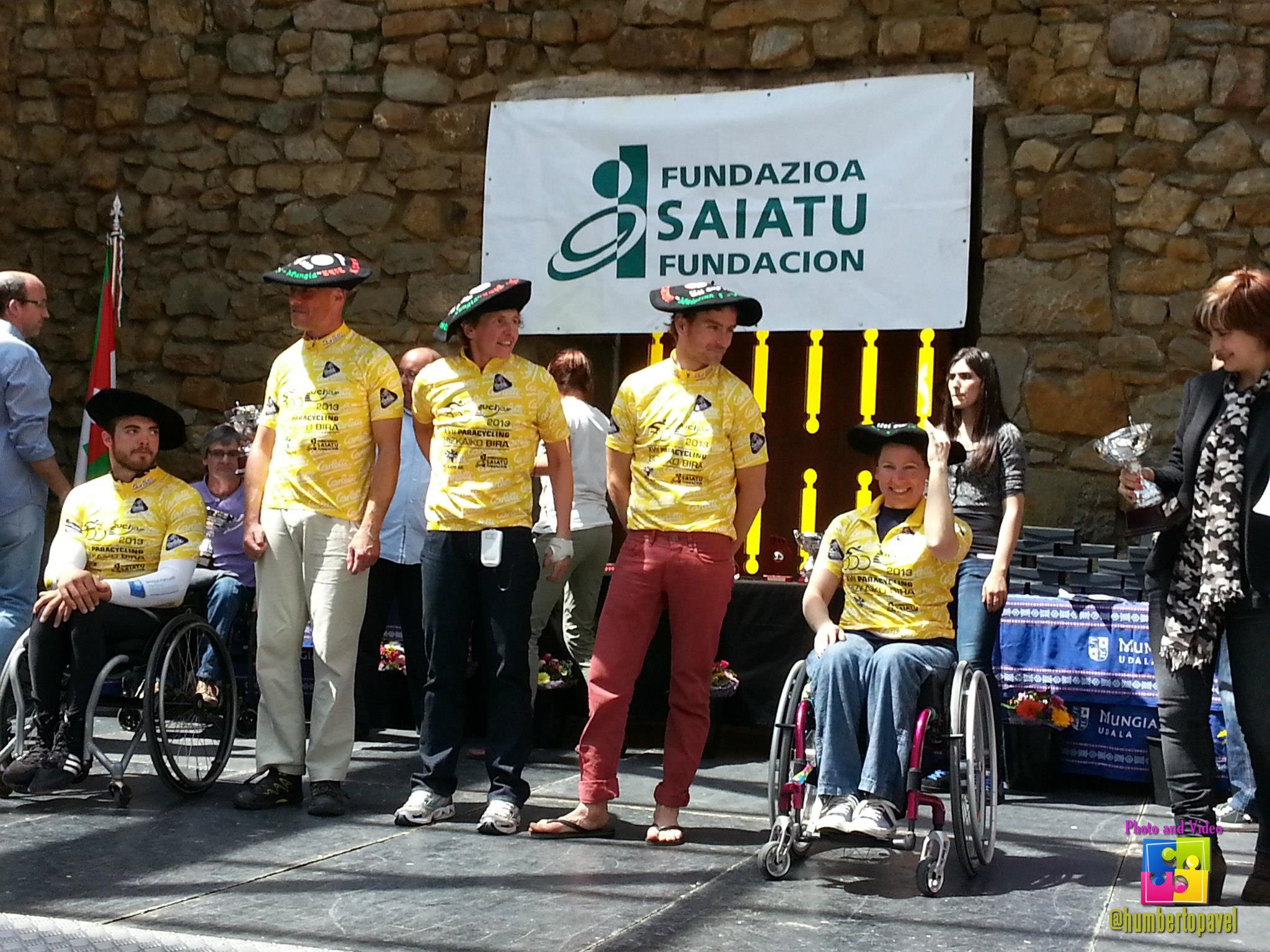
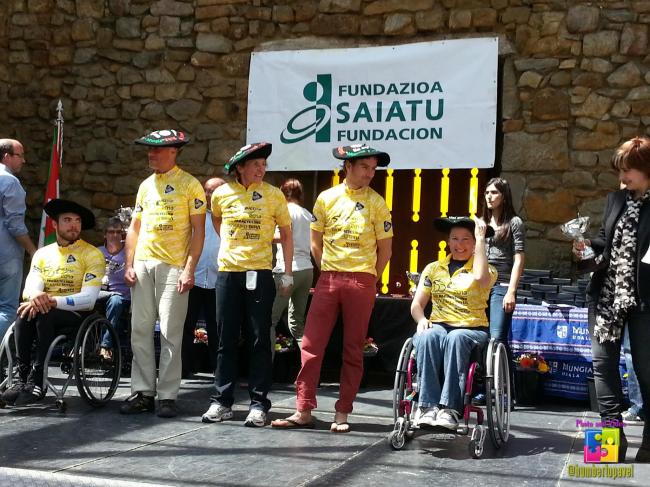
I had further problems in the Road race the next day when the ratchet in my gear shifter broke half way round, which meant I was stuck in a high gear for the climbs. Despite the set backs, I finished first in both races and was ‘crowned’ overall Champion with a rather charming felt ‘chapella’.

The pain from my shoulder was made bearable by the enormous hospitality and friendship at the after race prize giving and lunch provided by the organisers. I was even ferried to a Rehabilitation Centre the next morning for some more Physio treatment before my flight home, carrying a yellow jersey, three bottles of wine, a trophy, a medal, flowers and of course, my hat!

British International Disability Swimming Championships

Image

It’s not every day that you get the chance to pit yourself against the best Paralympic swimmers in the world 🙂

I love competing at Ponds Forge in Sheffield because a) I get to catch up with my friend Jo in Derbyshire, who cooks me fantastic food, and b) because I always PB!

Now, some people won’t believe that there are ‘slow’ and ‘fast’ pools, but believe me, there are! It’s all to do with how deep the pool is and how the water flows…and some physics which I don’t understand! Ponds Forge is definitely known as a ‘fast’ pool and attracts hundreds of competitors.

Despite not devoting much more than three hours a week in swim training over the winter due to the demands of training for the Virgin London Marathon, I managed two Long Course PB’s in the 100 and 400m Freestyle and was less than a second off my 50m Freestyle PB. Nice to know that improvement is still possible for other competitions this year.

London Marathon

Virgin London Marathon

Virgin London Marathon

Making the decision to run a marathon, only two years after first squeezing myself into a race chair, and taking part in two Half marathons, was not easy. I knew it would involve full commitment to a training regime over the winter and one of my disciplines would have to take a back seat for six months. A personal ambition of mine is to compete at the World Triathlon Championships in Kona in the future, so an attempt at the distance seemed like a good idea.

I travelled down to London with my borrowed kneeler racing chair, which Rick Hoskins at Stockport Harriers had kindly lent me instead of my very basic sitting chair with small pushrims and 650 wheels. After registration I caught up with friends and gossip over a buffet dinner provided by the organisers.

We travelled to the race start next morning and mingled with the Elite wheelchair racers. I chatted with Ernst van Dyk and said hello to Heinz Frei, who I hugely admire, then it was time to warm up, line up at the start and wait for the gun.

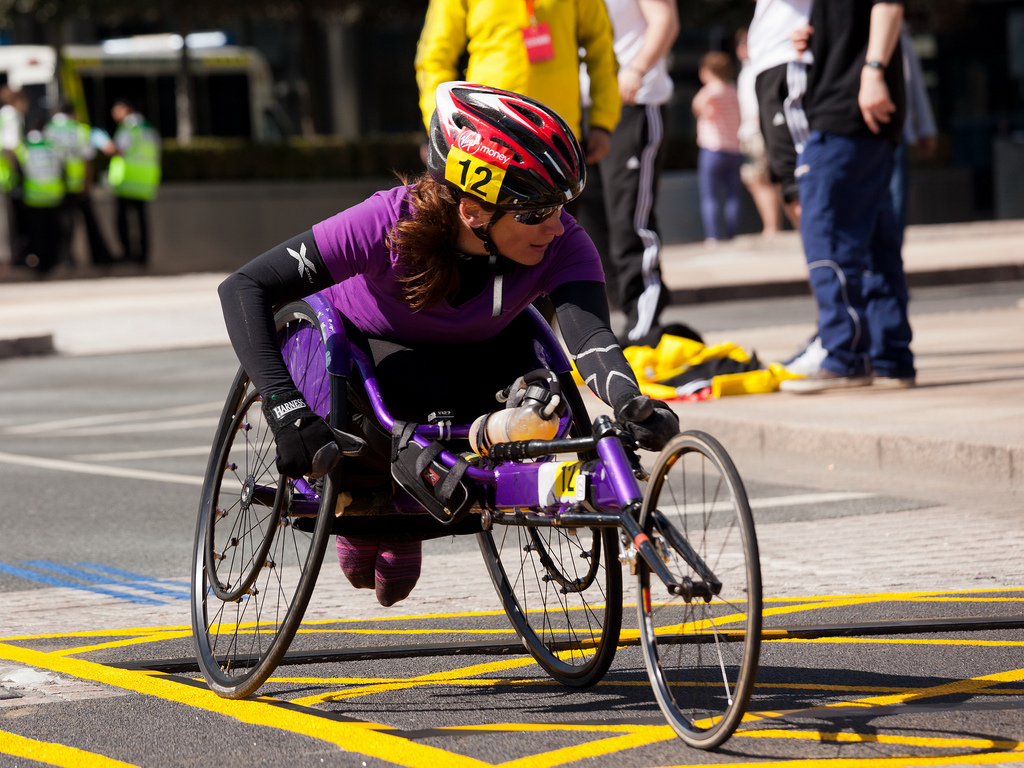
I knew I would have no-one to draft and it would be a solo effort, but I still set off at a rate of knots to try and latch on to someone. The organisers had said we would be pulled off the course if we didn’t reach the 11 mile mark by 1:20hrs. Paranoid about having a DNF, I did a 6 minute PB of 1:22:47 by 13 miles and paid for it in the second half.

I was sick three times, felt dizzy and my arms refused to work. I had hit the proverbial ‘wall’…but with wheelchair racing, there is no walking to recover, as the chair needs to be constantly propelled by the arms. It is at this stage that you learn the most about your inner strength and willpower to finish.

The crowds were absolutely amazing all round the course as thousands lined the route and created a huge wall of noise from both sides. At times I wanted to block out the noise and the few tunnels and underpasses on the course gave some relief. Then I heard individual voices-‘You rock!’, ‘Go purple lady!’, ‘Don’t stop!’ ‘You can do this!’- and regained some strength after a volunteer handed me a gel.

I finished the race in 3:13:40, to rousing clapping from the wheelies who had already finished, something which was better than any prize I’ve ever received.

Rossenau, France

Sometimes, things are not meant to be…

I met Chris Furber, former Para-cycling Lead Coach at British Cycling’s base in Manchester, after making a tentative application to the BC Talent Squad over the winter. The meeting was fruitful and informative and got exciting when I bumped into Jody Cundy in the corridor under the Velodrome. I was a little star struck, and it was lovely of Chris to introduce us.

I travelled to Rossenau in France for the first Para-cycling race of the European Handcycle Circuit (EHC) early in March, where Chis would watch me race and see if I could possibly be funded for the UCI World Cup in Sergovia in June, depending on my performance.

The weather on race day was appalling, with the temperature barely above freezing and steady rain. I find it hard to race in the cold as it has such an adverse affect on my tone and spasticity and I have problems with temperature control. I couldn’t stop the violent shivering on the start line despite a warm-up lap.

Chris Peterson from Top End was watching the race, having become a major sponsor of the EHC series of races in 2013. He had pointed me out to a colleague before the race “Watch this girl, this should be a good race”.

I pushed down hard on the cranks in a heavy gear, wanting to keep with Rachel Morris who had told me to stick behind her to draft for the race. There was a loud noise and my seat back collapsed underneath me as soon as I set off, rendering me unable to either see over the cranks or reach to pedal. I coasted to a halt barely 50m from the start line and instantly knew my race was over before I’d even started.

Some Marshalls and spectators ran over to help, but without allan keys to fix the seat brackets, there was nothing they could do. A mechanical on the first race of the year and my first ever DNF was not how I had hoped to start my racing season.

Silverstone Half Marathon

The first wheelchair race of the season, preparation for one of the bigger goal of 2013, the London Marathon, came after a winter of hail, snow, freezing temperatures and ice and yet more snow. My long training runs outside in thin lycra trousers, thick ski socks and three thermal layers on top plus snood under my helmet, were over, as I aimed to qualify for the Marathon with the help of Rick Hoskins, a wheelchair racing coach at Stockport Harriers.

Mid run Silverstone

The course at Silverstone is convoluted and challenging for wheelies and doubly so when Able Bodied runners (‘AB’s’) do their little dance as shown in the photo above in response to shouts of ‘Wheelchair! On your right!’ (Sorry number 2367!) when approached from behind.

Racing wheelchairs are silent machines, dependent entirely on the occupants upper body strength to strike the push rims attached to each back wheel and propel the user forwards. Stopping or slowing down means losing speed and having to overcome inertia again. There is only one brake attached to the 20″ front wheel, ineffective at high speed as it locks and skids and burns a hole in the expensive tub tyre. Another option is to use the gloved hands to scrub speed off directly on the back wheels, but replacements are £120 a pair…

Despite the dancing, I managed second place, with a time of 92:55, and was asked by Michelle Weltman if I wanted to do the London Marathon in March.